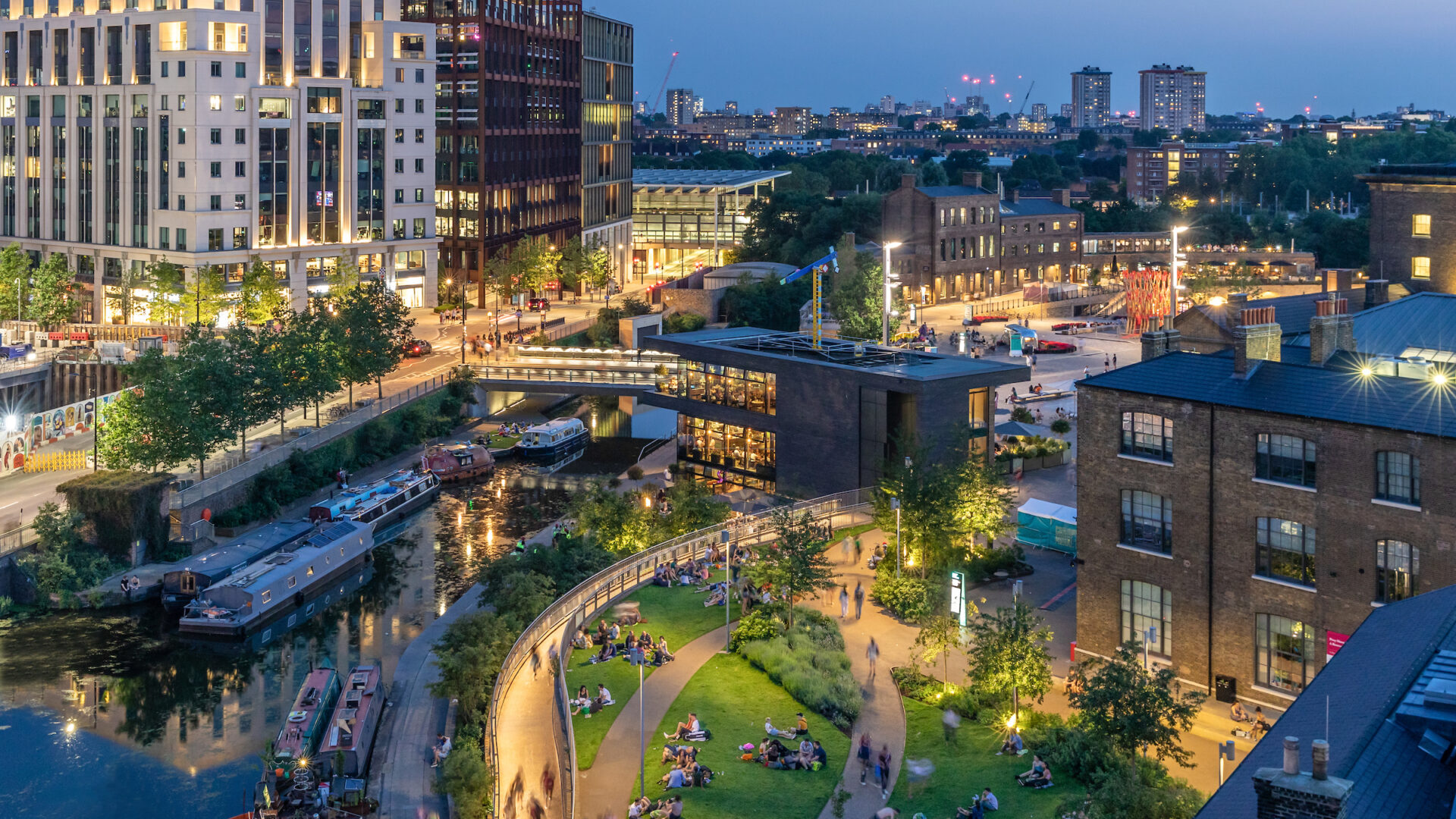
This year, the King’s Cross estate celebrates its 10 year anniversary. The milestone marks a decade since the opening of The Granary Building in Granary Square and the official reopening of the King’s Cross district to the local community and to London.
• Over the past decade, King’s Cross has outperformed all other London Opportunity Areas for employment and population growth.
•Mayor of London Sadiq Khan, shared his views of King’s Cross and the impact this landmark regeneration has had on the capital, and how it is a model which can help drive London’s recovery post-pandemic
• Today, the 67-acre King’s Cross Estate has capacity for 18,000 jobs and supports an annual GVA of £1.42bn. It has 1,120 homes, a further 623 under construction, with households contributing £21.2m in local expenditure
• At the heart of King’s Cross is Granary Square, and its 1,100 ‘dancing fountains’, which has welcomed more than 41m public visits since it opened in 2012
• From 9 October 2021, King’s Cross will take over its Outside Art Project with a ‘Then & Now’ photography exhibition to celebrate the anniversary and tell the story of this iconic part of London.
King’s Cross, London’s 67-acre neighbourhood, is today, 8 October 2021, celebrating a 10-year anniversary. The milestone marks a decade since the opening of The Granary Building in Granary Square, home to Central Saint Martins, and the official reopening of the King’s Cross district to the local community and to London.
The anniversary also marks 20 years since the publication of the Principles of a Human City. Published in 2001, this pioneering document set out the 10 principles which have underpinned the design and development of King’s Cross, with a focus on creating a robust urban framework and lasting new place; and promoting accessibility and a vibrant mix of uses.
Over the past two decades, King’s Cross has undergone a complete transformation and is regarded as an exemplar for urban regeneration. What was a derelict and underused railway and industrial site, the King’s Cross Estate now boasts 2.7 million sq ft net of office, retail, food and drink and leisure space, providing capacity for 18,000 jobs, and is home to c.120 different businesses. King’s Cross is a key office district for London and has established itself as a hub for creative, digital, and knowledge-based businesses, making a significant contribution to London’s place as a world city. King’s Cross is home to 2.1% of all creative, digital and cultural jobs in London’s Central Activity Zone, representing a remarkable 20,000% growth in ‘knowledge’ jobs in King’s Cross neighbourhood over the past decade. In 2021, close to 1 million sq ft of new office space was delivered, and there is currently 0% vacancy across the whole office portfolio.
King’s Cross is also a thriving residential neighbourhood, with 1,120 homes and 750 student residences. With construction of a further 623 homes and 450,000 sq ft of office space currently underway, more than 40,000 people will live, work and study in the neighbourhood when the development is complete.
The Estate has also set new standards for social and environmental sustainability. The King’s Cross partners established the King’s Cross Academy Trust, which set up and continues to run the King’s Cross Academy primary school, co-located with Frank Barnes School for Deaf Children. The Estate also runs visitor, construction skills and recruitment centres and direct the site wide energy company, Metropolitan King’s Cross. This company owns and operates the district energy centre and cooling pod for King’s Cross, supplying all homes and commercial space with heating, hot water and cooling. The district energy centre runs combined heat and power engines, now powered by renewable ‘green gas’. This is just one reason why the Estate boats more BREEAM ‘Outstanding’ buildings than anywhere else in the UK.
The Estate team looks after the new streets and public spaces, run a wide range of arts and events programmes, facilitate street food and markets and much, much more. It provides sports facilities, for all, including the Handyside indoor sports facility, used by the King’s Cross Academy primary school and others that live and work in King’s Cross.
The regeneration of King’s Cross has sensitively brought together the area’s rich industrial past – evidenced in the 20 repurposed historic buildings, including the iconic Gasholders London and Coal Drops Yard, the Victorian coal buildings which have been reimagined by Thomas Heatherwick – with modern architecture inspired by the history of King’s Cross.
Public realm changes have led the regeneration of King’s Cross, with the establishment of much-loved spaces such as Granary Square, Cubitt Square, Cubitt Park, Gasholder Park, and the Bagley Walk ‘high line’. More than 40% of the Estate is public realm, including green parks and gardens, new public squares and streets. Granary Square and its iconic fountains lie at the heart of the Estate. The popularity of King’s Cross is evidenced by the 41 million visits to Granary Square since its opening, with a total of 10.4 million visitors in 2019 alone.
Speaking about King’s Cross and its anniversary milestone, Sadiq Khan, Mayor of London, said: “King’s Cross is a vibrant area with a distinct character and lots of energy. In the past ten years it has completely transformed into not only a key office district for London, but a thriving residential neighbourhood. The urban regeneration of King’s Cross is a prime example of just the kind of innovation that will help encourage Londoners and domestic and international tourists back into the centre of our city and support our economic recovery from this devastating pandemic.”
Councillor Danny Beales, Cabinet Member for Investing in Communities, Culture and an Inclusive Economy at Camden London Borough Council, said: “Over the past ten years it has been amazing to see how King’s Cross has transformed. Disused railway sites have been replaced by new developments which benefit Camden residents of all ages and from all communities – fantastic facilities including the leisure centre and library at 5 Pancras Square, Frank Barnes School for Deaf Children, King’s Cross Academy and Central Saint Martin’s art college.“King’s Cross has become a centre for academic and scientific innovation – it forms the heart of the area now known as the Knowledge Quarter. The key next step is to ensure local residents can fully access the opportunities this brings. We want children growing up in Somers Town today to see a clear pathway through education in the area straight to working in the major tech companies or the leading scientific and creative industries that have made our borough their home. We are working with these institutions to create these pathways, not least in establishing apprenticeships and training schemes for Camden’s residents.”
Adding to this, Robert Evans, CEO at King’s Cross and Joint Managing Partner of Argent, commented: “Twenty years ago, in July 2001, I and others wrote some ‘Principles for a Human City’ about our approach to King’s Cross. We stated an objective to devise and deliver, over 15 or so years, an exciting and successful mixed-use development; one that will shape a sense, vibrant and distinctive urban quarter, bring local benefits and make a lasting contribution to London. King’s Cross should offer an urban exemplar for a sustainable world city. It should be an outstanding place to live, work or just ‘be’. It should make a significant, positive contribution to the economy, equality and the environment.
Fast forward and the King’s Cross Estate now boasts a world-class university, inspiring businesses, some 2,000 homes, an eclectic range of shops and restaurants, two schools, sport, leisure and community facilities. Bold new architecture complements powerful historic buildings and world-class public realm. Each day the Estate welcomes and attracts a mixture of students, workers, residents, shoppers, visitors and tourists. King’s Cross has a distinctive sense of place and community. It is regularly held up as a benchmark for development and regeneration in London; and we often welcome visitors from other cities, across the world, to share our approach to place-making and social value and our path to ‘net zero’ carbon.
We are proud of how we have achieved our original development objectives. In many ways, as we start the construction of our final buildings at King’s Cross, the place has already turned out even better than we hoped or expected. Increasingly, our focus now lies beyond the bricks and mortar, to providing those who live, work or spend time at King’s Cross, with the right content, experiences and services. King’s Cross shows how we can transform an urban area and improve lives with new facilities and investment, with private sector development and patient capital taking the lead, whilst working closely with local authorities and local communities.”
Paul Clark, Senior Investment Director at AustralianSuper, joint owners of the King’s Cross estate and part of the King’s Cross Central Limited Partnership, commented: “King’s Cross is the jewel in AustralianSuper’s European property investments and we are proud to have played an important part in its transformation. King’s Cross demonstrates what can be achieved through long-term investment and collaborative partnerships with a shared vision to build sustainable assets and communities. King’s Cross has set the benchmark for major urban regeneration development projects and cities to follow, and we are looking for new development opportunities that would enable us to help replicate its success globally.”
To mark the anniversary, King’s Cross will launch a retrospective ‘Then & Now’ photographic exhibition, visually telling the story of evolution at King’s Cross, utilising the imagery of long-term King’s Cross photographer John Sturrock. The exhibition will open on 9 October 2021 and is free to visitors.
Key achievements for King’s Cross over past decade:
- Tripling of King’s Cross’ economic contribution to London’s Central Activity Zone in the last decade
- 18,000 jobs capacity, delivering £1.4billion in annual GVA. Once complete, King’s Cross will have capacity for 22,000 jobs and deliver an additional £300m of annual GVA
- 500% increase in jobs over the past decade, surpassing all other central London districts
- 55% of jobs in the King’s Cross neighbourhood are creative, digital, or cultural, this is a 20,000% increase in creative, digital and cultural jobs over the past decade, also surpassing all other central London districts
- 1,120 homes currently at King’s Cross, with 623 currently under construction. When complete King’s Cross residents can contribute £35.9million annually to local economy and support 420 local jobs
- King’s Cross delivers £4.73 million of social value annually to the local community through support for local supply chain, local employment and contributions to community initiatives
- KX Recruit, the onsite employment service, has placed 1,300 into work, of which two-thirds have been local (Camden and Islington) and 40% are under 24 years old
- King’s Cross Construction Skills Centre has delivered 1,547 apprenticeships, more than 6,000 construction qualifications and helped nearly 2,000 people into construction employment
Key stats on King’s Cross over the past decade:
Community
• The King’s Cross Estate is home to two primary schools, King’s Cross Academy and Frank Barnes School for Deaf Children, and Central St Martins College of Art and design, part of the University of the Arts London (UAL).
• King’s Cross Academy and Frank Barnes School for the Deaf are co-located in the lower part of the Plimsoll Building.
• Since opening its doors in September 2015, with 87 students in the nursery and year 1 classes, the King’s Cross Academy has grown to a population of 446 pupils from nursery to year 6.
• Frank Barnes School for Deaf Children is one of the only schools in London with a truly bilingual philosophy – treating the learning of British Sign Language (BSL) and English with equal importance.
• The schools work with the businesses from across the King’s Cross estate to enable children to develop a rich, varied understanding of the world around them. Collaborations with businesses include Google’s coding specialists, engineers from Hoare Lea and the Waitrose cookery school.
• Funding from the King’s Cross Central Limited Partnership (KCCLP) since 2015 has enabled every student to learn a musical instrument, something that is not currently offered at any other state school in the UK.
• Central St Martins, part of UAL, came to King’s Cross is September 2011. The university is located in the Granary Building with a campus that extends 180 metres to the North of King’s Cross.
• Studios, workshops, and lecture theatres are built around a broad, covered “street” with overhead walkways. This fluid space enables students and staff from different departments to talk, work together and spark off one another.
• The CSM building also houses the 350-seat Platform Theatre and the Lethaby Gallery, which celebrates its 150-year anniversary this year.
Commercial
• King’s Cross is home to world-leading corporations including Google, Facebook, Universal Music and Havas.
• King’s Cross’ economic contribution to London’s Central Activity Zone has tripled in the last decade.
• The neighbourhood has seen a 500% increase in job generation, exceeding all other London Plan Opportunity Areas.
• In 2021, King’s Cross completed 1m sq ft of commercial space, including Facebook’s 11-21 Canal Reach.
• Major new office occupiers, including Nike and Sony, will join the King’s Cross neighbourhood in 2021/22.
• King’s Cross current office vacancy is 0% across the site.
• Earlier this month, King’s Cross announced a new partnership with The Office Group to create the first-ever purpose-built flexible workspace in King’s Cross.
Sustainability
• King’s Cross is an urban regeneration of a brownfield, former industrial site. It’s location, adjacent to key public transport hubs, ensures that sustainability is at its heart.
• The majority of the 67-acre King’s Cross Estate is pedestrianised, with vehicles pushed to the exterior, and more than 40% of the Estate is given over to open space – including parks, streets, and squares, with Granary Square and its iconic fountains as a heart.
• During the pandemic, King’s Cross increased the amount of pedestrian space in Granary Square by 25%, giving visitors even more traffic-free space to enjoy.
• King’s Cross is also home to one of the UK’s most sophisticated on-site energy centres. KCCLP owns 90% of the energy centre in partnership with Metropolitan UK, the district heat specialists.
• The energy centre efficiently generates heating and hot water for the whole of King’s Cross using large boilers and by capturing the heat generated by the Combined Heat & Power engines which provide renewable electricity for the estate.
• King’s Cross recently moved its entire gas supply to renewable ‘green gas’. This ensures that all heating and hot water for the estate’s 1,100 homes, 2 million square ft commercial space are powered by green gas.
• This deal reduced the carbon footprint of King’s Cross by 50%, saving 16,000t CO2 per annum.
• King’s Cross works with the London Wildlife Trust on its biodiversity strategy, this has seen over 40% of non-heritage roofs being greened, over 400 new trees planted and 600 species of flora flourishing on the Estate.